Tuesday, September 16, 2008

Justinian's Plague

The Plague of Justinian started in 541 AD. This was the very first record of the Bubonic Plague. Justinian's Plague spread quickly, and left destruction and death wherever it went.


Justinian's Plague began its reign of terror in 514AD, when Justinian the First was in the fifteenth year of his reign.


The plague first hit Egypt, in its small town of Pelusium. Then it spread through Alexandria, Syria and Palestine. The plague traveled northward and soon ended up in Constantinople. Soon, ten thousand people would die each day in the city alone.


The cause of the plague came from fleas. The fleas would be carried by rodents, in fact many of the people with the plague had been bitten by a flea. However, being bitten was not the only way to get this disease,
"by inhaling infected droplets from the lungs of someone whose plague infection has spread to the respiratory system." (source).


The Plague of Justinian started in 541 AD. This was the very first record of the Bubonic Plague. Justinian's Plague spread quickly, and left destruction and death wherever it went. Even though Justinian the First had built the Sancta Sophia during his reign (Mills 42), nothing could prepare him for this. The next time time the deadly disease would strike again with great force, would be called the Black Death (Blum Cameron Barnes 36).

Blum, Jerome, Rondo Cameron and Thomas G. Barnes. The European World: A History. Brown and Company, 1966.

Mills, Dorthy. The Middle Ages. G. P. Putnam's Sons: New York, 1935.

Saturday, September 13, 2008

William the Conqueror


William the Conqueror, or William the Bastard, was born in 1028. William conquered England and was made king in 1066 and died in 1087.


William was the son of Robert of Normandy and
Herleva. Robert and Herleva were not married so William was illegitimate. When Duke Robert went in 1030, but died when he was returning. William was now the Duke of Normandy at seven years old. However, young William was not without a guard. However, on March 15, 1037, William's great uncle died and by 1040, Turchetil, Alen, Gilbert and Osbern were killed. Finally, in 1040, William started to control Normandy.


When Edward the Confessor, King of England, died he had no descendant to rule England. Edward had made the claim that he was to be the next to receive the throne. However, Harold had already claimed the throne. To William, this was a betrayal, since Harold had given to William countless oaths.


King Harold had just defeated the King Hardrada, when the news that William of Normandy had just arrived at Pevense Bay, reached him. Harold made the mistake of driving his troops so hard that some of them fell behind, so he was left with a smaller army than he had after his defeat of Hardrada. He also refused to let his brother Gyrth lead the army to fight William, and as a result he ended up being shot with an arrow, and was killed. William the conqueror was in control of many old lands of Wessex and by December he even controlled London. Finally on the Christmas Day of 1066, he was made the King of England. Finally on September 9, 1087, William the Conqueror became sick and died. The entire Battle of Hastings is recorded upon the Bayeux Tapestry(Newman 63).


William the Conqueror, or William the
Bastard, was born in 1028. William conquered England with one mighty strike (Wernick72). However, every great mortal hero will eventually die, just as William died on September 9, 1087.

Newman B., Paul. Daily Life in the Middle Ages. McFarland & Company, Inc.: Jefferson, North Carolina. 2001.

Wernick, Robert. The Seafarers: The Vikings. Time-Life Books: Alexandria, Virginia, 1979.

Saturday, August 30, 2008

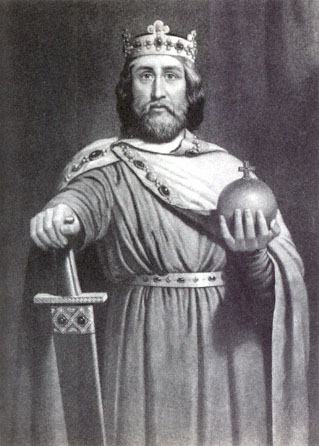
Charlemagne


Charlemagne was born in 742AD, and died in 814AD. Charlemagne was a n amazing warrior, who fought for his faith (Scott 28), and sent out amazing campaigns during his reign.


Charlemagne was a Roman Catholic, he lived from 742 AD to 814 AD. He was Pepin the third and Bertrada's son. When Charlemagne's father died in 768, he became king of the Western area of the kingdom of the Franks.

When Charlemagne's brother, Carloman died in 771, he took the kingdom and added it to his own. Over fifty campaigns were sent out during Charlemagne's rule. It was due to his amazing ability to organize his troops that Charlemagne was able to send out so many incredible campaigns. Charlemagne ruled the Western area of Europe by 800. He was able to unify most of the Roman Empire and provide a way for modern Europe's developement.

Charlemagne was part of the Carolingian Empire, and was the fourth member of this dynasty(Blum Cameron Barnes 17). Charlemagne ruled for forty three years. He was a Christian emperor, and, although he was religious he was also violent, for at a time during his reign he had over four thousand Saxon people executed within a day. However, Charlemagne also supported teaching and learning (Blum Cameron Barnes 17). Charlemagne's impressive reign ended in 814, when the incredible emperor died at the age of seventy one.


Charlemagne was born in 742AD, and died in 814AD. Although Charlemagne was somewhat violent, he supported education given by the Church (Blum Cameron Barnes 17). Charlemagne eventually died at when he was seventy one years old.

Blum, Jerome, Rondo Cameron, Thomas G Barnes. The European World: A History. Little, Brown and Company, 1966.

Scott, Martin. Medieval Europe. Martin Scott, 1964.

Saturday, August 23, 2008

Battle of Hastings


The battle was on October 4, 1066, between King Harold, and the Duke William. This would prove to be an important battle; England would never be the same after The Battle of Hastings.


The problem began when King Edward, or Edward the Confessor, died. His son was not yet old enough to take possession of the throne and the nobles did not approve of him, so Harold Godwinson took up the throne in England. However, William, who was from Normandy, wanted the throne, as did the ruler of Norway, Harald Hadrada.


Harold was successful in defeating Harald Hadrada. The celebration of his victory would not last, for word reached King Harold that William of Normandy had reached Pevensey Bay. When he met William's force he was at a disadvantage, for many of his men were not able to travel at the demanded speed (source).


The battle was on October 4, 1066. William of Normandy was able to receive help from several places in exchange for a share of the land. The two armies met in battle, and, eventually, Harold was killed and William's force was able to crush Harold's army. William eventually became king on the Christmas of 1066.


The battle of Hastings took place on October 4, 1066. This battle was between the Saxons and the French. The French eventually won the battle, and William claimed the throne of England.


Sunday, May 25, 2008

This Year's Class

This years history class worked very well for me. As a matter of fact, there isn't a lot I would change about the blogs or assignments. Watching movies helped to understand the subject we were studying. Blogs also helped in understanding what we were learning, and if for some reason we weren't able to get a blog done, being excused for it or giving more time helped a lot.

The only thing that I would change about the class is the amount of time we spent going over the blog topic, because I was pretty lost on a couple of blogs we did. However, the blogs helped in understanding the topic we were studying because we were able to go over it in writing the blog and in our research.

Whenever we couldn't get a blog in for whatever reason, giving us more time or excusing us helped, because we didn't have to be tied down all the time and stressed out about a lower grade that we couldn't help getting because of whatever the situation, whether it was a family or health issue. However, the blogs weren't the only things that helped in understanding the subject.
The work done in class helped out as well

Watching movies helped us out a lot because the book didn't go in depth on anything, and by watching movies and taking notes in class, we were able to get into the subject and understand it more than if we would have just read the book. Whenever, we came to an important part in the movie, pausing it and explaining what was going on helped because when you let a movie run without pausing it and you're trying to take notes while the narrator keeps talking and going on to other important subjects, you miss a lot of the important points.


Many things worked out very well this year, like the blogs, the movies we watched in class and giving us more time if we needed it on our blogs. However, it would've helped a lot if we went over the blog topics in class more thoroughly.


Saturday, May 17, 2008

Christianity and Islam


Islam and Christianity are two extremely different religions. However, they are somewhat similar.


The morality of Christianity and Islam are extremely different. According to Islam, men can have four wives, even though Muhammad had more wives than four. According to Christianity having more than one wife is, in fact, a sin. Jesus and Muhammad were very different. First of all, Mohammad was from an angel, Gabriel (Corrick, 89) that he claimed claimed to be from God. Jesus claimed not only to be from God, but to be the Son of God, and he proved it by rising from the dead. Mohammad never rose from the the dead. the Koran requires obedience to Allah (Pirenne, 151), and a Christians should be obedient to God, however, that is not how we get to heaven, Romans 3:24, "and are justified freely by his grace through the redemption that came by Christ Jesus." source.


Christianity and Islam are similar because according to the five tenants of Islam alms are to be given to the poor (Corrick, 91). Christians also should care for the poor and needy. Also, according to the five pillars of Islam, Muslims should pray every day. Christians should also pray every day, and spend quality time with God.


However, there are also differences between Islam and Christianity. For Instance, the Hajj, or a journey to Mecca in ones lifetime, is required in the Islamic faith. In the Christian religion, we are not required to go on a journey to Jerusalem or Mecca. However, God wants us to "go make disciples of all nations" source.


Although Islam and Christianity are two totally different religions, they do share a few similarities. However, just because two religions may have a few similarities doesn't at all mean they have a common purpose.


Corrick A., James. World History Series: The Early Middle Ages. Lucent Books Inc.: San Diego, 1995.

Pirenne, Henry. Mohammad and Charlemagne. Barns & Noble Inc., 1992.

Friday, May 9, 2008


The only thing that separated Islam from the West area was the Byzantine Empire. This empire was able to survive the main Muslim attacks.The The Muslims were able to conquer the southern areas of the Byzantine Empire, such as, Syria, the Jordan and Egypt. However, the Byzantines did not allow Islam to take control of the ocean (Pirenne, 184). The Byzantines were able to defeat an attack on the city of Constantinople (Corrick, 75).


The wealth of Syria and the Islamic spread were the reasons the Muslims decided to wager war upon Syria. However, they were originally going to declare war upon the area, it was but a way of defense against the people there. Though eventually, it turned into a holy war against Syria.


Jerusalem is actually one of the most holy sites for Islam. It was conquered in 634 by the Muslims. they ruled for four hundred fifty years, and possibly had a greater effect upon the city than did Christianity.


It was in 640 AD that Egypt was conquered by Amr bin Al-As. He also put the Fortress of Babylon under siege , then the Byzantine surrendered in 641. Amr bin Al-As went to Alexandria and they also gave in, or surrendered, to the Muslims.


The only thing that separated Islam from the West area was the Byzantine Empire. This empire was able to survive the main Muslim attacks.The The Muslims were able to conquer the southern areas of the Byzantine Empire, such as, Syria, the Jordan and Egypt. However, the Byzantines did not allow Islam to take control of the ocean (Pirenne, 184). The Byzantines were able to defeat an attack on the city of Constantinople (Corrick, 75).

Corrick, A. James. World History Series: The Early Middle Ages. Lucent Books Inc.: San Diego, 1995.

Pirenne, Henri. Mohammed and Charlemagne. Barns and Noble Inc., 1992.